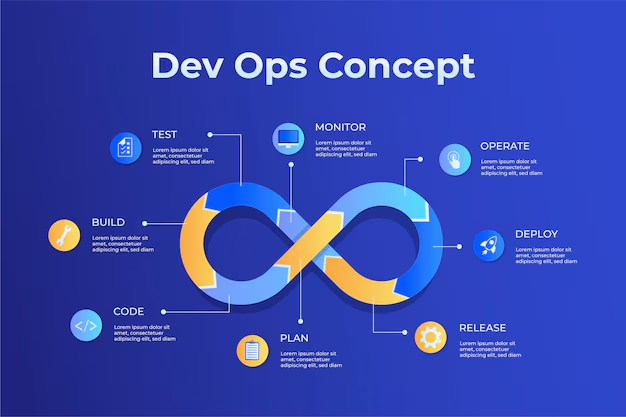
Industry-standard DevOps best practices for building reliable CI/CD pipelines at scale.
Introduction
DevOps is a cultural and technical approach that unifies development and operations teams to deliver software faster, more reliably, and at scale. By integrating automation, collaboration, continuous delivery, and monitoring, DevOps enables organizations to respond rapidly to market changes, customer needs, and technological evolution.The goal of DevOps is to reduce the gap between development and operations, eliminate bottlenecks, and create a continuous feedback loop that improves software quality, stability, and user satisfaction.
Automation
Automation reduces manual work by leveraging scripts, tools, and workflows to handle repetitive tasks across development, testing, and deployment, increasing efficiency, consistency, and reliability.
CI/CD
Continuous Integration and Continuous Deployment (CI/CD) pipelines enable fast, safe, and frequent releases by automating code integration, testing, and deployment processes, reducing errors and accelerating delivery.
Monitoring
Comprehensive monitoring tracks system health, application performance, and infrastructure metrics in real-time, helping teams detect issues early and maintain high availability and reliability.
Security
Security-focused DevOps practices ensure that pipelines, infrastructure, and applications are protected from vulnerabilities through automated checks, access controls, and compliance monitoring.
Culture
A collaborative DevOps culture aligns teams, promotes shared responsibility, continuous learning, and proactive problem-solving, fostering efficiency, innovation, and high-performing teams.
Digital Innovation
DevOps is a cultural and technical methodology that bridges the gap between software development (Dev) and IT operations (Ops). Its goal is to deliver software faster, with higher quality, and more reliability, by promoting collaboration, automation, and continuous improvement.
Speed
Faster release cycles enable teams to deliver features and updates quickly, respond to market demands, and maintain a competitive edge without compromising quality.
Quality
High-quality software minimizes bugs and defects through automated testing, code reviews, and best practices, ensuring reliable performance and user satisfaction.
Stability
Stable systems are designed to handle failures gracefully, maintain uptime, and provide consistent performance, ensuring trust and reliability for users and businesses.
Scale
Enterprise-ready systems are built to handle large user bases, high traffic, and growing data volumes efficiently, ensuring performance and reliability as the business grows.
Feedback
Quick feedback loops from monitoring, testing, and user insights enable teams to learn rapidly, iterate on features, and continuously improve the product and processes.
Key Architecture
A DevOps pipeline is a structured set of automated processes that take software from development to production in a consistent, reliable, and efficient manner. Designing an effective pipeline is critical to ensure faster releases, higher quality software, and minimal operational risk.
Pipelines
Automated pipelines orchestrate the flow of code from development to production, including building, testing, and deploying applications, ensuring consistent and repeatable processes.
Infra
Infrastructure as Code (IaC) allows teams to define, provision, and manage infrastructure through version-controlled code, improving consistency, scalability, and automation across environments.
Secrets
Secure management of sensitive keys, tokens, and credentials ensures that applications and infrastructure remain protected from unauthorized access and security breaches.
Testing
Automated testing validates code changes through unit, integration, and end-to-end tests, reducing bugs, maintaining quality, and enabling faster, safer deployments.
Rollback
Safe rollback mechanisms allow teams to revert deployments quickly in case of failures or issues, minimizing downtime and reducing risk to users and business operations.
"Great architecture is built to change — not to last forever."
Future Outlook
DevOps has transformed software development and IT operations by promoting collaboration, automation, and continuous delivery. As technology evolves, the future of DevOps is being shaped by emerging trends, advanced automation, AI, cloud-native environments, and DevSecOps practices.
AI Ops
AI Ops leverages artificial intelligence to automate IT operations, including monitoring, incident detection, and remediation, enabling faster response times, predictive maintenance, and optimized system performance.
GitOps
GitOps is an operational model where Git serves as the single source of truth for infrastructure and application deployments, enabling automated, version-controlled, and auditable operations.
Security
A 'shift-left' security approach integrates security practices early in the development lifecycle, identifying and resolving vulnerabilities during coding and testing rather than after deployment.
Cloud Native
Cloud-native architectures leverage containerization, microservices, and orchestration platforms like Kubernetes to build scalable, resilient, and easily maintainable applications.
Scale
Global systems are designed to handle large volumes of traffic and data across multiple regions, ensuring high availability, performance, and reliability for users worldwide.